
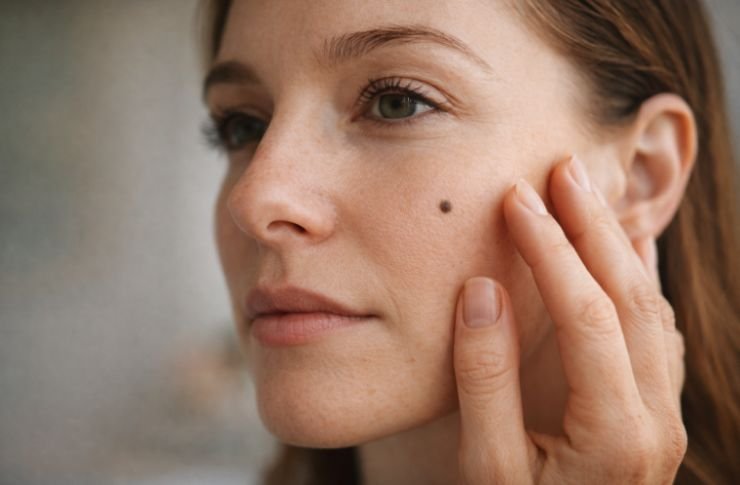
Many people search beauty mark vs mole after noticing a new dark spot on their skin and wondering whether it is harmless or something serious. The confusion happens because the two terms are often used interchangeably in everyday conversation, yet they carry different meanings in medical and cosmetic contexts.
In simple terms, a beauty mark is usually just a mole located in a visually attractive area, most commonly the face, while a mole, medically called a nevus, is a cluster of pigment cells that can appear anywhere on the body.
Understanding this difference matters because while most are harmless, some skin spots require monitoring, and knowing how to recognize changes allows you to evaluate your skin calmly rather than react with fear.
Key Takeaways
- A beauty mark is simply a mole located in an aesthetically noticeable area, usually the face
- Most moles are harmless and develop due to genetics and normal skin growth
- The ABCDE rule helps identify warning signs that need medical attention
- Location does not determine danger, changes over time do
- Removal is optional unless a dermatologist recommends it
- Regular observation is more important than panic
- Early evaluation prevents serious complications
What a Mole Actually Is?
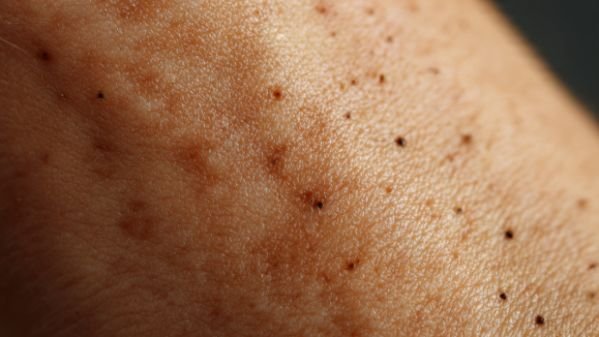
A mole forms when melanocytes, the cells responsible for skin color, grow in a concentrated group rather than spreading evenly, creating a darker spot compared to surrounding skin.
Moles may appear during childhood, adolescence, or early adulthood and may remain unchanged for decades while others fade slowly over time.
They vary widely in shape and color, appearing flat or raised, smooth or rough, with shades ranging from light brown to nearly black and occasionally pink or skin colored.
The key point is that location does not define a mole because a spot on the back, scalp, arm, or foot is biologically identical to one on the face.
Why People Call Some Moles Beauty Marks

The term beauty mark is cultural rather than medical and is used when a mole appears in an aesthetically pleasing area such as near the lips, cheek, or collarbone.
Historically these marks were even artificially created in fashion eras to enhance appearance, yet the biological structure never changes.
The difference between beauty mark vs mole is therefore interpretation rather than structure, where one is a medical term and the other is a cosmetic label.
Physical Characteristics Compared
Beauty marks are usually small and round because larger or irregular ones are less commonly considered attractive, whereas moles can vary widely in size.
It tend to be uniformly dark brown or black, while moles may include multiple shades such as tan, red, pink, or mixed pigmentation.
Beauty mark typically have symmetrical borders and appear mostly on visible areas of the face or neck, whereas moles may be symmetrical or irregular and appear anywhere on the body including hidden areas.
Why Skin Spots Develop?
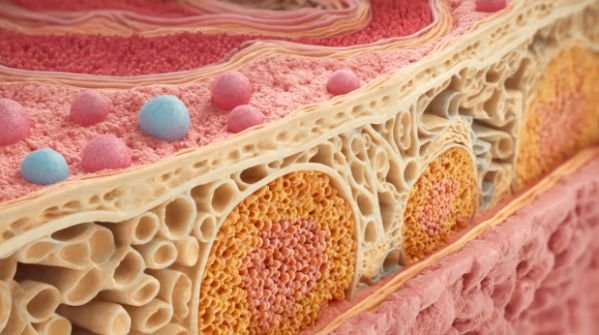
Most moles develop due to genetics and natural skin growth patterns, although sun exposure influences how visible they become because ultraviolet light stimulates pigment cells.
Hormonal changes during puberty and pregnancy may temporarily darken existing moles or cause new ones to appear. Some people naturally have many moles while others have very few, and this variation is normal and not automatically linked to disease risk.
When a Mole Becomes a Health Concern
The primary concern related to beauty mark vs mole confusion is melanoma risk, which occurs when pigment cells grow uncontrollably.
Dermatologists use the ABCDE rule to evaluate risk: asymmetry when halves differ, border irregularity, uneven color, diameter larger than about six millimeters, and evolving changes over time.
Any of these signs suggest medical evaluation is necessary, not because cancer is certain but because early detection is safest.
Common Myths About Beauty Marks and Moles

Many believe raised moles are more dangerous, but flat and raised lesions carry similar risk levels. Another myth suggests hair growing from a mole indicates cancer, whereas hair growth often indicates a healthy follicle and is usually harmless.
Scratching a mole does not cause cancer either, though repeated injury should still be avoided because irritation makes real changes harder to observe.
Cosmetic Removal Options
Some individuals remove moles for appearance reasons, and dermatologists usually perform minor surgical excision or laser treatment depending on depth.
Attempting removal at home is unsafe because it prevents proper examination and may cause infection or scarring. A removed mole is typically tested to confirm normal cells, which provides reassurance.
Monitoring Skin Safely at Home
Monthly skin checks under good lighting help detect unusual changes early, and mirrors assist in viewing difficult areas such as the scalp and back. Photographing moles over time helps compare gradual change more accurately than memory.
Consistent observation is more valuable than frequent checking because awareness prevents anxiety while maintaining safety.
Children and Moles

Children commonly develop new moles during growth years as the skin expands and pigment cells redistribute, a process influenced by Genetic Regulation of Pigment Cell activity, and sudden appearance alone is not dangerous unless the spot behaves differently from others.
Parents should focus on pattern change rather than total number to determine whether evaluation is needed.
Emotional Impact of Visible Marks
Facial marks can influence self perception positively or negatively depending on cultural context. With some individuals embracing them as identity features while others prefer removal.
Neither choice changes medical importance because stability rather than appearance determines safety, and understanding beauty mark vs mole reduces unnecessary worry while encouraging appropriate monitoring.
Frequently Asked Questions
1. Can a beauty mark turn into cancer?
Any mole has potential risk but most remain harmless throughout life.
2. Are new moles normal in adulthood?
Occasional new moles may appear, but suddenly numerous spots should be examined.
3. Do darker moles mean higher risk?
Color alone does not indicate danger, but uneven color requires evaluation.
4. Should all facial moles be removed?
Removal is optional unless medical changes occur.
5. Is laser removal safe?
When performed by a dermatologist it is generally safe after evaluation.
Understanding the Reality Behind Skin Spots
Understanding beauty mark vs mole separates cosmetic perception from medical reality. Because nearly every beauty mark is biologically a mole and most remain harmless throughout life.
The goal is awareness rather than fear, and watching for consistent change while seeking evaluation. When necessary ensures safety without unnecessary treatment. Clear knowledge allows confident decisions about monitoring or removal while maintaining healthy skin habits.